Switchback
Running

Training science companion for ultra trail.
Free and open-source.

Dawn over the ridgeline. Scent of Jeffrey pine. That towering summit you can't see just yet. Switchbacks. Blue sky. Switchbacks again. The effort is the prize.

Your ultra trail training companion reviews your running log, helps plan your build, and paces you to your next starting line.

Your training data,
through the lens of science

Switchback connects to your Intervals.icu account and helps you think through your training by anchoring every recommendation in established exercise science.

Review a workout. Flag a recovery concern. Adjust your week. Build a race-day plan. All through natural conversation.

switchback

Your watch. Your data. Your companion.

⌚
Your watch
Garmin, Suunto, COROS,
Apple Watch, Strava...
→
📊
Free. Syncs your
training data.
→
🤖
AI Agent
The brain.
Free with Gemini CLI.
→
⛰️
Switchback
Your training companion.
Grounded in exercise science.

The agent is the brain. Switchback is the companion — training science built in. Both run in your terminal — the installer sets everything up for you. No coding required.

Install

$ curl -fsSL switchback.run/install.sh -o /tmp/sb.sh && bash /tmp/sb.sh click to copy

The installer guides you step by step — no coding needed. When it's done, type:

$ switchback click to copy

Free with Gemini CLI (no credit card needed). Also works if you use Claude Code, Codex CLI, or OpenClaw.

Not a coach.

Switchback is a companion: presenting your data, explaining tradeoffs, and letting you decide. When you can work with a real coach, you absolutely should. Switchback is for the many of us who train alone and want something better than a static plan.

This project is for informational and educational purposes only. It is not medical advice. Always consult a qualified healthcare professional before starting or modifying a training program. Stay safe out there.

Your companion. Your rules.

During setup, you choose a name and personality for your companion. The default is Virgil — Dante's faithful companion on his journey to hell and back. Rename it after a training partner, a runner you admire, or that aid station volunteer who saved your race at mile 40.

You also choose the tone, humor, and style that work for you. Casual or structured. Brief or detailed. Fired up or analytical. It adapts to how you want to train.

Train By The Book

The authors of these books made exercise science accessible to self-coached trail runners. Switchback stands on their shoulders.

Buy the books. Seriously. Understanding your own body and how to prepare it for a race is worth every page. Read them and your runs will be richer — and Switchback more useful. You'll also support authors who've dedicated their careers to helping runners like us go after our dreams.

We're not affiliated with these authors. If you can work with them directly, you should!

FAQ

Is it free? Do I need a GitHub account? Does it work on my phone? Is it only for ultrarunners?

Read the FAQ

GenAI for Health Workshop @ NeurIPS 2026

Switchback: A Long-Horizon Agent System for Ultrarunning Training

Romain Lacombe · romain@switchback.run

Long-horizon human–AI collaboration on the trail

Preparing for an ultratrail race is a months-long experiment in physiological adaptation. Training decisions must account for long-term goals, fitness gains, short-term fatigue, recovery, illness, weather, and physiological data uncertainty, with significant consequences for athlete health.

We present Switchback, an open-source agent system that combines a structured constitution, user-owned memory, task-specific skills, an exercise science knowledge base, with tools for accessing wearable data. We deployed Switchback for 174 days while the author-runner prepared for three ultratrail races, covering 102 runs, 1,154 km, 34,554 m of climbing, and 180 elapsed hours, alongside more than 3,100 user and agent messages and 540 million total API tokens.

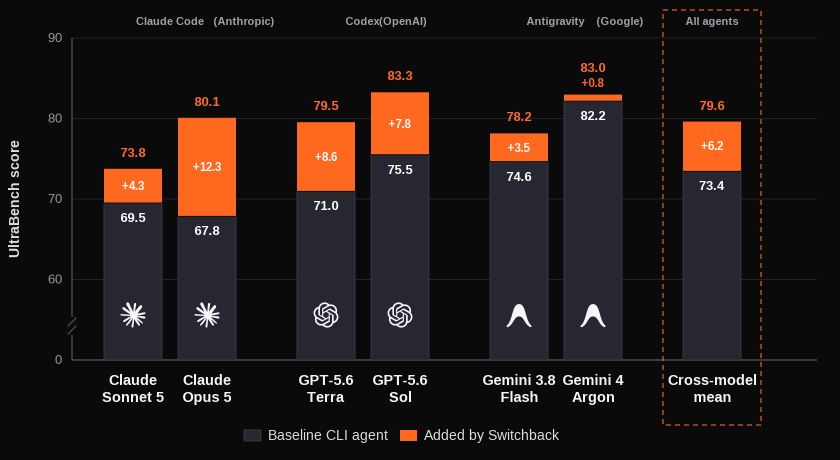
Lessons from this six-month user–agent collaboration shaped UltraBench, a synthetic benchmark of 60 scenarios evaluating training agents for health safety, adaptation, constructive planning, memory stewardship, and tool orchestration. Across 48 held-out scenarios and six models from three providers, Switchback raised the cross-model mean score from 73.4 to 79.6 points (+6.2 points, +8.4%; 95% CI 4.2–8.2) against baseline CLI agents with identical access to files and tools. Even frontier models capable of proficient advice make safer, better-grounded decisions when anchored by structured tool-use, explicit health guardrails, and an exercise science knowledge base.

174 days
Continuous field deployment across 3 ultratrail race builds
1,154 km
102 runs & 34,554 m of vertical gain logged
3,105
Athlete & companion messages (540M total API tokens)
+6.2 pts
Mean gain on 48 held-out UltraBench-Test scenarios

Constitution, memory, science & tools

Switchback keeps its rules in inspectable repository files rather than hidden chat state. At each turn, a compact, harness-agnostic COMPANION.md loads the athlete's profile and persistent notes, routes to a task skill, retrieves relevant exercise-science chapters and live provider data via MCP, and proposes an explanation or verified action.
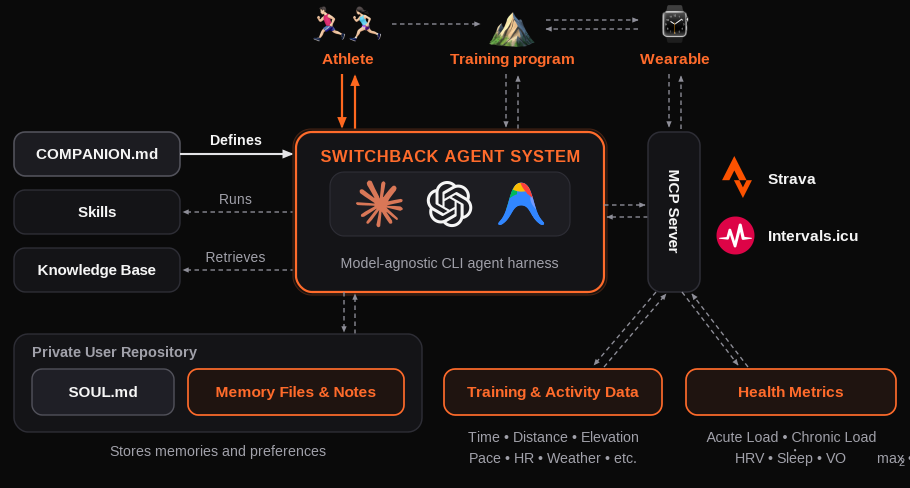
Switchback system architecture diagram
Figure 1: Switchback architecture. The athlete and agent iteratively shape a training program; wearable devices produce health and activity data synchronized through Intervals.icu and, optionally, Strava. A structured COMPANION.md defines a model-agnostic CLI agent system that runs task skills, retrieves curated knowledge and user-owned memory, archives compact activity notes, and queries MCP servers for training-calendar, health, activity, and weather context.

Health-First Triage

A four-level triage ladder protects long-term health ahead of race goals or today's workout while choosing the least restrictive safe adaptation.

User-Owned Memory

Profile, sourced notes, and compact Markdown activity records live in a private local Git repository—portable across Claude, Codex, and Gemini.

Contested Science

20 reference chapters synthesize peer-reviewed physiology with frameworks from Johnston, Koop, Magness, and the Roches, surfacing expert tradeoffs.

Six months on the trails: Miwok 100K, Broken Arrow 46K & CCC

From March 8 to August 29, the author-runner developed and used Switchback across a complete season of mountain ultrarunning:

  • Mar. 24 – May 2 · Miwok 100K Build, Fever & Debrief
    Identified a duration gap five weeks out, enforced a conservative shutdown during a pre-race fever, and analyzed GPS segments after a mile-48 cutoff DNF to separate muscular descent durability from fueling and aid-station execution.
  • May 3 – Jun. 22 · Post-DNF Recovery & Broken Arrow Skyrace 46K
    Used recovered HRV, sleep, and Achilles status to rebuild conservatively, culminating in a 9h02 finish with 8,700 ft of climbing at Broken Arrow that validated the revised sodium and fueling strategy.
  • Jun. 23 – Aug. 29 · CCC Build & Race-Eve Alpine Reroute at UTMB
    Adapted the build around travel, illness, and athlete recovery constraints, then rebuilt the entire checkpoint, pacing, and 81 g/hr nutrition plan on race eve when severe alpine storms forced a course reroute through Martigny and Trient.

Read & cite the paper

Download the camera-ready PDF (switchback-paper.pdf) or browse it inline below:
@inproceedings{lacombe2026switchback, title = {Switchback: A Long-Horizon Agent System for Ultrarunning Training}, author = {Lacombe, Romain}, booktitle = {The Third Workshop on GenAI for Health: Agentic Systems, Clinical Trust, and Future Potential at NeurIPS 2026}, year = {2026}, url = {https://switchback.run/switchback-paper.pdf} }
CLI Agent Evaluation Benchmark

UltraBench

A 60-scenario executable benchmark testing whether CLI agents retrieve the right wearable evidence, protect athlete health under pushback, steward longitudinal memory, and verify tool writes.

Evaluating trajectories, not static Q&A

Fluent coaching advice alone cannot show whether an agent found the right dates, distinguished a single bad night from a multi-day trend, held a safety boundary when an athlete pushed back, or verified a calendar write. UltraBench runs native CLI coding agents inside isolated synthetic athlete workspaces backed by a stateful local MCP server.

20 scenarios (3 dev / 17 test)

Safety & Adaptation

Illness, injury red flags, heat/altitude hazards, overreaching trends, and athletes pushing for unsafe workouts or race starts.

20 scenarios (3 dev / 17 test)

Constructive Planning

Multi-week block design, taper adjustments, race-day pacing/nutrition, and trading off competing exercise-science frameworks.

10 scenarios (3 dev / 7 test)

Memory Stewardship

Archiving compact activity notes, preserving dated hypotheses without promoting them to facts, and respecting privacy boundaries.

10 scenarios (3 dev / 7 test)

Tool Orchestration

Reconciling Intervals.icu and Strava records, confirming calendar writes before execution, and verifying resulting state.

48 held-out scenarios across six models

We refined Switchback on the public 12-scenario UltraBench-Dev split, froze the 1,077-word specification, and evaluated it on the 48 held-out UltraBench-Test scenarios across six models from Anthropic, OpenAI, and Google. Both conditions receive identical files, MCP tools, and three-turn athlete dialogues; each trajectory is scored blind by a three-judge panel (Claude Opus 5, GPT-5.6 Sol, and Gemini 4 Argon).

UltraBench-Test results across six models
Figure 2: UltraBench-Test scores on 48 held-out scenarios. Baseline CLI agent scores in charcoal and paired gains from the Switchback specification in orange.
Target Model CLI Harness Baseline (95% CI) Switchback (95% CI) Paired Δ (95% CI)
Claude Sonnet 5 Claude Code 69.5 [64.2, 74.5] 73.8 [69.5, 77.6] +4.3 [-0.5, 9.3]
Claude Opus 5 Claude Code 67.8 [62.6, 72.9] 80.1 [76.3, 83.4] +12.3 [7.9, 17.0]
GPT-5.6 Terra Codex CLI 71.0 [65.8, 75.8] 79.5 [75.4, 83.3] +8.6 [4.7, 12.6]
GPT-5.6 Sol Codex CLI 75.5 [70.2, 80.4] 83.3 [79.2, 86.9] +7.8 [2.9, 12.4]
Gemini 3.8 Flash Antigravity CLI 74.6 [71.6, 77.5] 78.2 [75.2, 80.7] +3.5 [0.8, 6.1]
Gemini 4 Argon Antigravity CLI 82.2 [80.0, 84.2] 83.0 [81.3, 84.6] +0.8 [-1.5, 3.3]
Across models 6 models 73.4 79.6 +6.2 [4.2, 8.2]

Paired Gains by Task Stratum

Switchback produced its largest improvements on safety and adaptation (+9.8 points) and constructive planning (+6.5 points), while the smaller gain on agent operations (+1.8 points) highlights remaining challenges in tool verification and longitudinal memory stewardship.

Target Model Safety & Adaptation Constructive Planning Agent Operations
Claude Sonnet 5 +8.6 +4.0 -0.4
Claude Opus 5 +16.7 +11.1 +8.5
GPT-5.6 Terra +11.4 +10.1 +3.8
GPT-5.6 Sol +15.5 +8.9 -2.2
Gemini 3.8 Flash +3.3 +3.8 +3.6
Gemini 4 Argon +3.5 +1.2 -2.6
Across models +9.8 +6.5 +1.8

Open development split & harness

We release the 12-scenario UltraBench-Dev split at hf.co/datasets/rlacombe/ultrabench and the full evaluation harness in evals/ so researchers and builders can test their own prompts, skills, and models. The 48 held-out test scenarios remain private to prevent benchmark contamination.

git clone https://github.com/rlacombe/switchback-running.git cd switchback-running python3 evals/run_ultrabench.py --validate-only python3 evals/run_ultrabench.py --split dev --condition both --targets sonnet